Federal Reserve Chairman Kevin Warsh speaks during a news conference at Federal Reserve headquarters in Washington, July 29, 2026.
Win Mcnamee | Getty Images
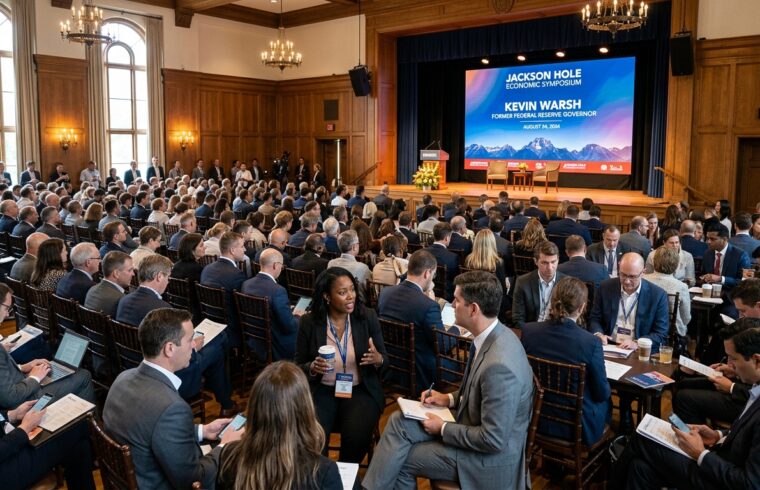
The Federal Reserve is bracing for a pivotal moment as Chairman Kevin Warsh prepares to deliver a high-stakes keynote address during the annual symposium in Jackson Hole this Friday. Anticipation is running high, with keen market watchers and economic analysts eager to decode his message regarding monetary policy and its broader implications on the economy. This year’s symposium, themed “Financial Innovation: Implications for Payments and Policy,” presents Warsh with a significant platform to articulate his vision.
Since taking office in May, Warsh has adopted a notably different approach compared to his predecessors by focusing more on market dynamics rather than traditional Fed signals. This strategy has left many uncertain about what Warsh will reveal at Jackson Hole, creating a palpable sense of curiosity and caution among economists and investors alike. Luke Tilley, chief economist at M&T Bank, summed it up: “I think it’s hard to predict what he’s going to say,” indicating that expectations are anything but clear-cut.
Warsh’s establishment of five task forces underscores his commitment to reassessing the foundational functions of the Federal Reserve. These groups are tasked with examining critical issues, including inflation perceptions, policy outreach, the influence of data on decisions, technological advancements, and the intricacies of communications. His hands-off approach aims to allow market forces to dictate responses rather than directly steering the Fed’s message, a tactic that has sparked mixed reactions amid ongoing volatility.
With the current economic landscape dominated by rising Treasury yields and fluctuating investor sentiment, Warsh’s forthcoming speech carries particularly high stakes. Joseph Brusuelas, chief economist at RSM, articulated the anticipated tension: “The market has now bid this up to be something that I think the Federal Reserve would rather it not be.” As the market reacts to fiscal measures announced by Treasury Secretary Scott Bessent, including significant increases in Treasury buybacks, Warsh must navigate a delicate balance between maintaining independence and addressing external pressures.
Market Impacts
A prevailing concern among analysts is Warsh’s reluctance to provide explicit forward guidance or detail the reaction function, which denotes the conditions under which the Fed might alter its policy stance. The absence of clarity during his address could lead to significant market repercussions. Mark Cabana, head of U.S. rates strategy at Bank of America, emphasized that if Warsh focuses on overarching themes such as productivity rather than concrete inflation metrics, it may be perceived as a dovish signal, prompting shifts in long-dated Treasurys.
Such a perception could notably increase the 30-year yield, pushing it beyond 5.5%—a level not reached in over two decades. As the implications of his speech loom large, clarity in Warsh’s comments will be crucial. Analysts argue that vague narratives will not suffice; Warsh will need to provide detailed insight on inflation dynamics and monetary policy mechanics to reassure markets and maintain stability amidst a volatile period.
Implications and Future Directions
The ramifications of Warsh’s speech extend beyond immediate market reactions. As the Federal Reserve attempts to carve out its role in a rapidly evolving financial environment, the significance of transparency and communication becomes paramount. Warsh’s unique approach, allowing markets to self-regulate based on data interpretation, presents both opportunities and risks. Economists like Brusuelas have cautioned that he may find himself “in between a rock and a hard place,” where Treasury actions inadvertently undermine the Fed’s dialogue.
As the financial landscape shifts, potential solutions may involve Warsh committing to a more transparent approach in future speeches. This could enhance trust in Fed policy while mitigating market volatility. The dialogue surrounding monetary policy is evolving, necessitating leadership from the Fed that is clear, consistent, and responsive to changing market conditions.
Conclusion: Warsh’s upcoming address in Jackson Hole is being closely watched as it may set the tone for the Federal Reserve’s direction in the coming months. The interplay of his remarks, market perceptions, and external economic factors raises vital questions. Will Warsh succeed in providing the clarity needed to guide the market through uncertain waters? How will his approach shape the Fed’s policy going forward? Can effective communication rebuild trust in the Federal Reserve’s framework amidst ongoing market upheaval?
Editorial content by Skyler Thompson